


Industry · Wastewater Treatment
Odor Control at Wastewater Treatment Plants
At a treatment plant, odor does not come from one point; it comes from every link of a chain that runs from the screens to sludge storage. The dominant compounds are hydrogen sulfide, mercaptans and ammonia. ODORGO does not mask these compounds; it attracts, binds and neutralizes them through electrostatic adsorption and an acid-base reaction.
Industrial-scale applications in Turkey are evaluated project by project and on request. Equipment selection, dosing, and product and safety documentation are defined for each plant; this page makes no performance, consumption or suitability commitment for your plant. The information below is meant to show which questions to bring to the preliminary assessment meeting.
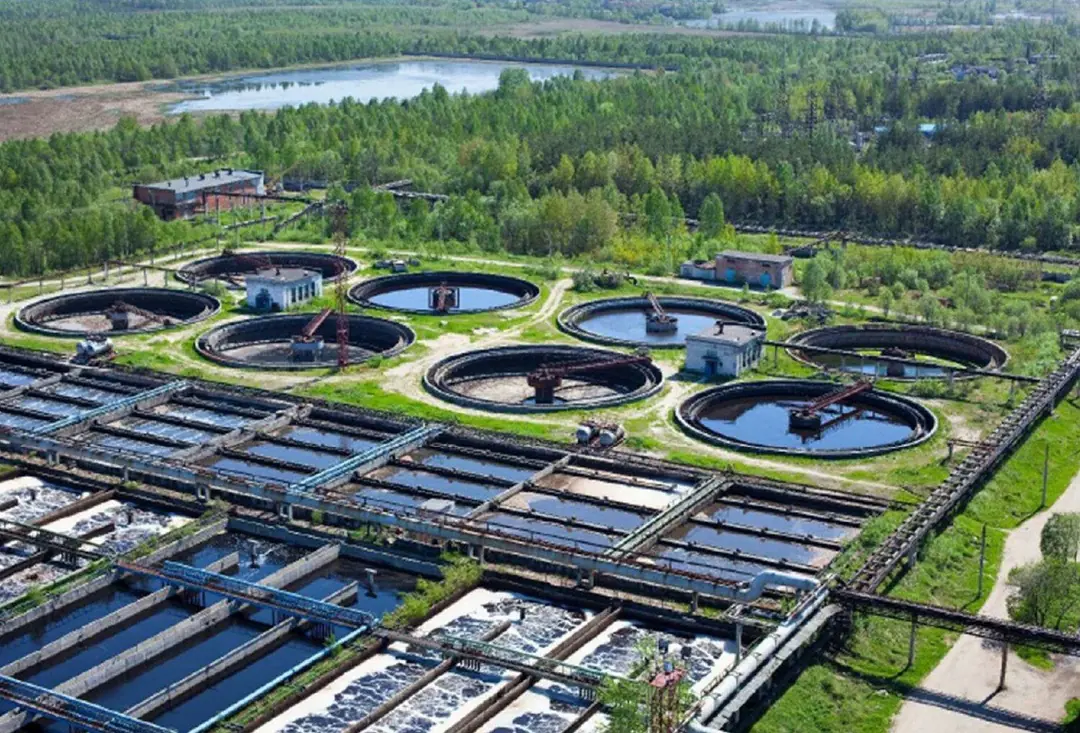
Where does the odor come from at this plant?
The source changes with where you are in the process and what time of day it is. A plant does not have one "odor problem"; it has six or seven separate ones, and each calls for a different solution.
The first point where raw wastewater enters the plant; this is where the odor load is released most abruptly. Water that has turned septic in the collector releases its dissolved hydrogen sulfide the moment it meets air. The containers where screenings are held are a second source.
The scum layer on the surface and the sludge that settles to the bottom create a wide emission area on the open tank surface. The source is not a point but the whole surface, and it moves with the wind.
In surface-aerated systems, turbulence carries dissolved gases straight into the air. As retention time in the thickener grows, anaerobic activity and odor load rise together.
The belt press, decanter and centrifuge areas are among the plant's most intense odor outlets. Mechanical compression and turbulence carry bound odorous compounds into the air. If this happens inside an enclosed building, worker exposure is a separate issue as well.
As holding time grows, anaerobic activity increases. The peaks that occur during truck loading are the most frequent trigger of neighbor complaints.
These are usually located inside or very close to residential areas. When a cover is opened or a pump starts, a concentrated burst of odor is released. These points also count as confined spaces; see the workplace safety section below.
Workplace safety first: odor removal is not a gas measurement
Hydrogen sulfide is not just an odor; it is a lethal gas. At low concentrations it smells like rotten eggs; at high concentrations it paralyzes the sense of smell and becomes odorless. So when a person says "the smell is gone," it does not mean the hazard is gone. It may mean the opposite.
For this reason, an ODORGO application never replaces the plant's gas measurement, ventilation and confined-space work procedures:
- In wet wells, channels, tanks and enclosed volumes, a fixed or portable gas detector is mandatory, and an odor application does not change that.
- The confined-space entry permit, ventilation and attendant procedure are applied as they are.
- A drop in odor intensity is not a measure of exposure; limit values for H₂S, ammonia (NH₃) and other parameters are monitored separately.
Personnel working with the concentrated product wear chemical-resistant gloves and goggles with side protection; dilution and filling are done in a ventilated area. This is a separate matter from the diluted mist in the application area.
How does it work?
The product is diluted with water and atomized as a fine mist into the air stream where the odor is released. Through the plant-derived oils, the electrostatic charge on the water droplet and an acid-base reaction, it attracts, binds and neutralizes the odor molecule. Five mechanisms work together behind the scenes: solubility (the odor gas dissolves inside the droplet), adsorption (molecules hold on to the droplet surface), absorption (the gas passes into the droplet), partitioning (the gas becomes more inclined to stay in the liquid phase) and reaction (oxidation/reduction and complex formation produce non-volatile products).
Performance is directly proportional to the total droplet surface area that comes into contact with the odor molecule. The target droplet size is below 25 microns, ideally below 10 microns. When the same volume of liquid is split into smaller droplets, the total surface area grows in inverse proportion to droplet diameter: using 10 microns instead of 100 microns gives 10 times, and compared with 1000 microns, 100 times the surface area. This is why the product is atomized rather than "sprayed." The same fineness also increases drift in open areas, so a perimeter layout is never designed without accounting for wind direction, wind speed and the distance to the property line.
Application by unit
One system is not installed for the whole plant. Because each unit has a different odor character and air movement, equipment is selected unit by unit.
| Unit / point | Odor character | Typical approach |
|---|---|---|
| Screens and grit chamber | Sudden H₂S peaks, confined volume | Point dosing; in-duct atomization in the enclosed volume |
| Primary settling tanks | Diffuse surface emission | Vapor-phase system or an atomization line around the tank |
| Aeration and thickening | Dissolved gases released by turbulence | Line around the tank; dosing at the exhaust outlet in enclosed systems |
| Sludge dewatering building | Intense, continuous indoor load | Vapor-phase system in the enclosed area; dosing in front of the exhaust fan |
| Sludge storage and cake yard | Anaerobic odor that peaks | Perimeter line; portable misting fan during loading hours |
| Pumping station / wet well | Localized, concentrated burst | Point dosing with a pneumatic nozzle, subject to the confined-space procedure |
| Plant property line | Wind-dependent dispersion | Vapor-phase perimeter line; layout based on wind direction |
| Tank cleaning, breakdowns, emergencies | Temporary and unpredictable | Mobile misting fan and portable atomization unit |
Equipment family
It needs no water connection and produces a very fine dry mist while adding the least possible moisture to the air. Installed along the site perimeter, it meets the odor at the property line; it suits large settling tanks and wide enclosed volumes.
Used for diffuse odor emissions; it produces droplets of 10 microns and below at high pressure, with nozzles placed at equal intervals along the line. It can also be installed as a nozzle ring at stack and exhaust outlets.
Nozzle-free centrifugal atomization blows an ultra-fine mist over a wide area or at a point source. It suits temporary sites, emergencies, truck loading hours and isolated odor zones.
Used at localized sources such as wet wells, tank vents, drainage points and air ducts. Because compressed-air (pneumatic) nozzles can run without electricity, they are an option at points that require an explosive-atmosphere assessment.
What it does and does not do
Where we stand on the regulatory side
In Turkey, odor is an environmental issue that is expected to be managed, and once a complaint arrives it stops being a technical matter and becomes an administrative file. The relevant framework:
- Regulation on the Control of Odor-Causing Emissions (Official Gazette 19.07.2013/28712): olfactometric measurement, the complaint procedure and limit values are defined in this regulation.
- Environmental Law No. 2872: administrative sanctions in case of violation; the sanctions are not limited to fines.
- Regulation on the Management of Industrial Emissions (Official Gazette 14.01.2025/32782, in force 01.12.2025): it requires facilities in scope to hold the SYD (Sanayide Yeşil Dönüşüm, Green Transformation in Industry) certificate; this does not replace the environmental permit and license document, it comes on top of it.
- Environmental Permit and License Regulation: the odor issue may come up in permit and license processes.
To be honest: The techniques listed for wastewater treatment plants in the annex to the Odor Regulation are covering and collection, biofilters and similar methods; odor neutralization by atomization is not on this list. Whether techniques outside the annex are acceptable is subject to the authority's assessment. For this reason we position ODORGO not as a regulatory compliance tool but as a way to manage complaints and neighborhood pressure; we recommend that you evaluate it together with the consultant who runs your official process.
Measurement and evidence
The process: four steps
Plant capacity, units, the points where odor release is concentrated, distance to the nearest residential area, complaint history and any measurement records are collected.
An odor profile is built from the data and the priority units are identified. Where needed, an online session is held with our technology partner's technical team in Switzerland.
Unit-by-unit equipment selection, dosing and layout are engineered; product and safety documentation specific to the plant is shared at this stage.
On-site installation, commissioning and field fine-tuning are carried out; continuous technical service and dosing optimization follow.
Frequently asked questions
The product is not a disinfectant or a biocide and carries no claim about microorganisms. That said, we also have no measured data on its effect on activated sludge biomass. For this reason, the layout is planned so that the product is not carried into the biological process.
No, and this is the most important sentence on this page. A drop in odor intensity is not a measure of exposure. Gas measurement, ventilation and confined-space work procedures continue as they are.
No. This is not a corrosion control product; protecting concrete or metal requires a separate solution.
Wind direction and speed directly affect open-area and perimeter layouts; fine droplets are prone to drift. In cold climates, freeze protection, line drainage and icing risk are solved at the project stage. The product is stored between 4 and 29 °C and protected from freezing.
We give no consumption or cost figure on this page; both depend on air flow rate, odor load, equipment type and operating regime. After the assessment meeting they are shared in a calculation specific to your plant.
The technology has been in use in the US and Europe for more than 35 years. Industrial applications in Turkey are carried out project by project; in the meeting we tell you plainly whether there is a reference we can share.
Most of the application can be done without stopping operations. With mobile units, a temporary solution can be put in place in a short time and the permanent system installed afterward.
The right dose is the balance point where neither the bad odor nor the product's scent is noticeable. Overdosing does not give the desired result, which is why dosing is determined by a site test.
Let's build your plant's odor profile together
Fill in the short form and we will put the data on the table at the assessment meeting. Product, dosing and safety documentation specific to your plant is shared at that stage.
Preliminary assessment form Contact us on WhatsAppDownload the Application Survey Form (PDF)
For all industries, the equipment family and a comparison with alternative methods, see the Industrial Odor Control page.
Trigonium İlaç A.Ş. · Esentepe Mah. Büyükdere Cad. No:201, Loft Residence, İç kapı No:40, Şişli / İstanbul · Phone: +90 212 982 68 45