


Sefa Karta, Senior Chemist · Last updated: November 8, 2026
ODORGO Natural Roll-On Deodorant 75 ml: contains no aluminum chlorohydrate, perfume, alcohol or dyes; it doesn't stop sweating; it prevents sweat odor. If several people at home use it, take a look at the 3-pack; it qualifies for free shipping on its own, and the current special price is on the product page.
You're standing in front of the store shelf with two bottles in your hands. One says "aluminum-free" in big letters on the front; the other says "potassium alum" in small print on the back. They seem to contradict each other. Which one should you believe?
Most of the time, both are telling the truth. They're just talking about different things. In this article, I'll unpack those few words one by one: how a product that reduces sweat differs from one that prevents odor, which suits whom, and how to read the label in thirty seconds.
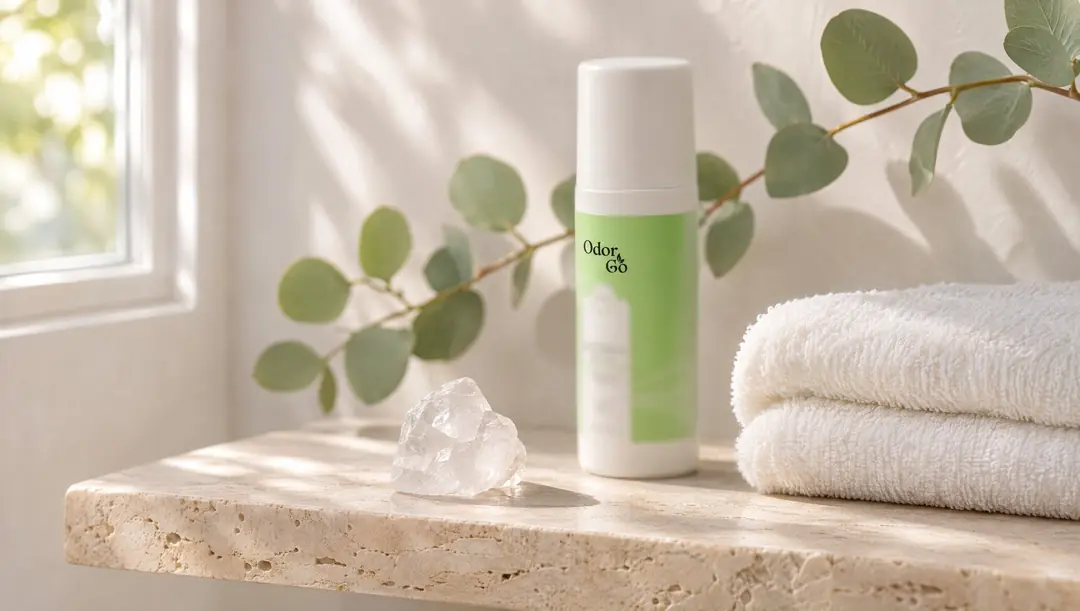
What does "aluminum-free roll-on" mean?
On the shelf, the phrase is mostly used to mean "a deodorant that isn't an antiperspirant." Antiperspirants contain aluminum chlorohydrate or aluminum zirconium compounds to reduce sweating. These salts form a temporary plug at the opening of the sweat duct, so the underarm stays drier. In the US, these products are regulated as over-the-counter (OTC) drugs; which aluminum compounds can be used, and at what concentrations, is set out in the US Food and Drug Administration (FDA) monograph.[1]
A deodorant has a different job. It doesn't try to stop sweat; it focuses on stopping odor from forming. So when you see an "aluminum-free" label, the first question to ask is this: is this product going to reduce my sweating, or prevent body odor?
What's the difference between an antiperspirant and a deodorant?
| Antiperspirant | Deodorant (such as ODORGO Natural Roll-On) | |
|---|---|---|
| Purpose | Reduce wetness | Prevent sweat odor |
| Typical active ingredient | Aluminum chlorohydrate, aluminum zirconium | Potassium alum and skin-care ingredients |
| How it works | Temporarily plugs the opening of the sweat duct | Limits the conditions odor-causing bacteria thrive in |
| Sweating | Reduced | Continues |
| Marks on clothes | Depending on the formula, may leave white marks or yellow rings | ODORGO Natural Roll-On leaves no yellow or white stains |
| Who it's for | People bothered by wetness | People bothered by odor who don't want to interfere with sweating |
Each does its own job well; neither is "better" than the other. Someone about to give a presentation who doesn't want sweat marks on their shirt might reasonably choose an antiperspirant. If the real problem is that sharp smell that shows up late in the afternoon, a deodorant is enough.
Why does sweat smell?
There are two main types of sweat glands in the underarm: eccrine and apocrine. Eccrine glands release mostly water-based sweat to cool the body, and this sweat is almost odorless. Apocrine glands become active after puberty and produce a thicker secretion that contains lipids and proteins. Odor appears when bacteria on the skin break down certain precursor compounds in this secretion; thioalcohols and short-chain acids are the main sources of that familiar sharp smell.[2]
That's why you don't need to stop sweat to prevent odor. Making things harder for the bacteria is enough, and that's what a deodorant does.
Is potassium alum aluminum? How to read the label
Yes, potassium alum contains aluminum. It's the chemical name for the "alum stone" you might remember from old-school barbershops. It's listed openly in the ingredients of ODORGO Natural Roll-On, too.
The difference lies in why the ingredient is added to the formula. Aluminum chlorohydrate is added to block the sweat duct. Potassium alum, on the other hand, leaves a thin layer on the skin and helps limit the growth of the bacteria that cause sweat odor. After you apply it, you keep sweating; what changes is how your sweat smells.
When you read the label, check these five things:
| What you see on the label | What it means |
|---|---|
| Aluminum Chlorohydrate / Aluminum Zirconium | The product is an antiperspirant; it reduces sweating |
| Potassium Alum | Mineral deodorant active ingredient, alum stone; doesn't block sweat ducts |
| Parfum / Fragrance | The product partly covers odor with another scent |
| "Stops sweating" claim | Antiperspirant |
| "Prevents sweat odor" claim | Deodorant |
On cosmetics, ingredient lists use INCI (International Nomenclature of Cosmetic Ingredients) names, which is why you'll see English and Latin names on the label rather than everyday words. Also look for the open-jar symbol: it shows how many months you can use the product after opening it.
Why do people choose a roll-on without aluminum chlorohydrate?
Some people looking for this kind of product don't want to stop sweating. People who go to the gym, or who work in a hot kitchen or on a construction site, know they're going to sweat anyway. What they care about is not smelling of sweat when they get home in the evening.
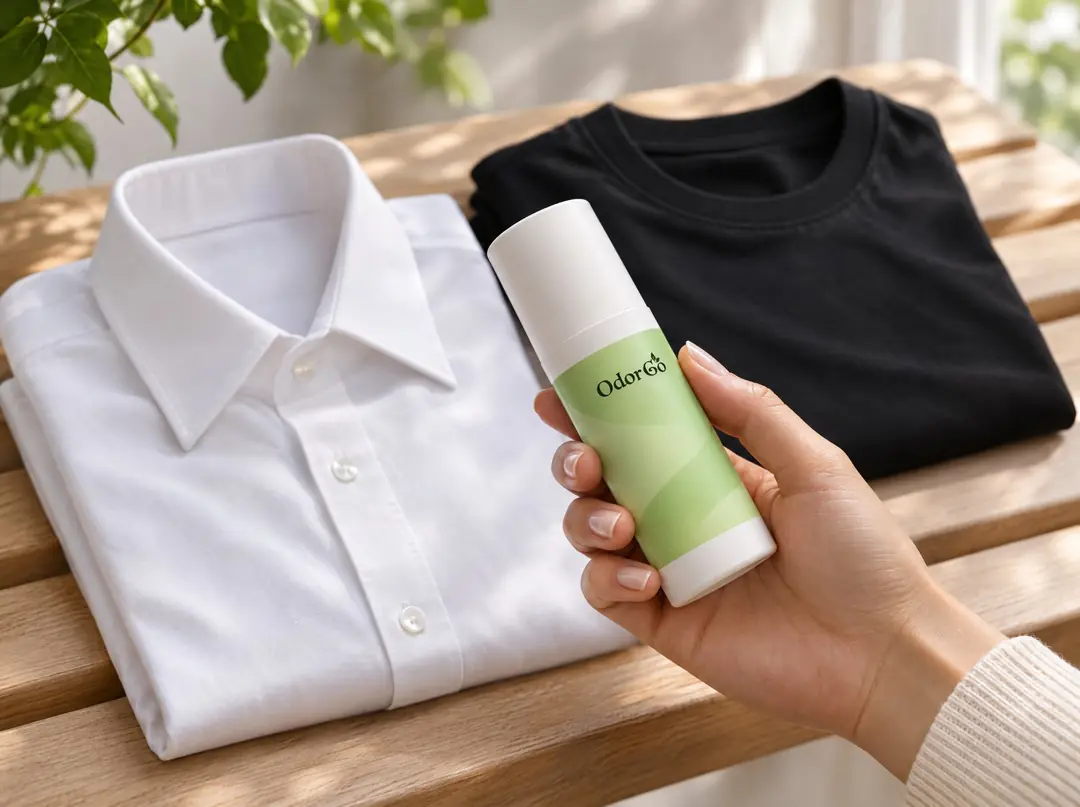
Some are tired of the marks on their clothes: white streaks on a black T-shirt, yellow rings under the arms of a white shirt. ODORGO Natural Roll-On leaves no yellow or white stains on clothes.
And then there are people who love their perfume but don't like their deodorant's scent mixing with it. They're looking for an unscented product. ODORGO Natural Roll-On contains no perfume; you won't smell anything when you put it on.
Which one suits you depends on your day. Is it the wetness that bothers you, or the smell?
Does an aluminum-free roll-on prevent sweating?
No. The products that reduce sweating are antiperspirants containing salts like aluminum chlorohydrate. An aluminum-free roll-on doesn't interfere with sweating; it stops sweat from meeting bacteria and turning into a bad smell. Fresh sweat is often nearly odorless. We go into more detail in our article on why sweat smells.
People switching from an antiperspirant may say "I'm sweating more" in the first few days. Sweating doesn't increase; the underarm that the antiperspirant kept dry simply gets damp again, and you notice it more in the first few days. The odor protection stays.
Does aluminum cause cancer?
This question comes up a lot, and it deserves an answer backed by a source. According to the US National Cancer Institute (NCI), there is no conclusive scientific evidence linking antiperspirant or deodorant use to breast cancer.[3] Still, if you'd rather avoid aluminum, the choice is easy: pick a deodorant whose ingredient list doesn't include "Aluminum Chlorohydrate" or "Aluminum Zirconium."
How do you use ODORGO Natural Roll-On?
- Shake the bottle before use.
- Dry your underarms thoroughly after showering.
- Apply a thin layer.
- Get dressed once the product is dry.
Don't apply it to irritated or freshly shaved skin; wait for the skin to calm down. The product is for adults and is not for use on babies or children. We recommend using the bottle within 6 months of opening.
The formula's active ingredient is potassium alum. Alongside it are niacinamide (vitamin B3), panthenol (provitamin B5), alpha arbutin and Centella asiatica leaf extract. It contains no aluminum chlorohydrate, perfume, alcohol or dyes. The full ingredient list is on the product page.
We've gathered more tips on what to look for in our guide on how to choose a natural deodorant.
Keep your underarms fresh
If you want to prevent odor without interfering with sweating, take a look at our natural deodorant options. For free shipping and current special prices, see the 3-pack page. If anything else is on your mind, visit our Frequently Asked Questions page.
Frequently Asked Questions
What does an aluminum-free roll-on do?
It prevents sweat odor; it doesn't stop sweat. It doesn't contain salts like aluminum chlorohydrate that block sweat ducts.
Does ODORGO Natural Roll-On contain aluminum?
It contains no aluminum chlorohydrate. Its active ingredient is potassium alum, which is also an aluminum salt, but it isn't used to block sweat ducts.
Does an aluminum-free roll-on stop sweating?
No. You keep sweating; what changes is that your sweat doesn't turn into a bad smell.
Are potassium alum and alum stone the same thing?
Yes. Alum stone is the everyday name for potassium alum.
What's the difference between an antiperspirant and a deodorant?
An antiperspirant reduces sweating; a deodorant prevents sweat odor. Antiperspirants contain salts like aluminum chlorohydrate.
Will I sweat more after switching to an aluminum-free deodorant?
No. You simply notice again the wetness the antiperspirant was suppressing; the amount of sweat doesn't increase, and odor is prevented.
Does deodorant with aluminum cause cancer?
According to the US National Cancer Institute (NCI), there is no conclusive scientific evidence linking antiperspirant or deodorant use to breast cancer.
Does it stain clothes?
No. ODORGO Natural Roll-On leaves no yellow or white stains. Just wait until it's dry before getting dressed.
Can men use it too?
Yes. All adults, women and men alike, can use it.
Can I apply it right after shaving?
No. Don't apply it to freshly shaved or irritated skin; wait for the skin to calm down.
Sources
- US Code of Federal Regulations (CFR), 21 CFR Part 350, Antiperspirant Drug Products for Over-the-Counter Human Use. https://www.ecfr.gov/current/title-21/chapter-I/subchapter-D/part-350
- Natsch A, Emter R. The specific biochemistry of human axilla odour formation viewed in an evolutionary context. Philosophical Transactions of the Royal Society B, 2020; 375(1800): 20190269. https://pmc.ncbi.nlm.nih.gov/articles/PMC7209930/
- US National Cancer Institute (NCI). Antiperspirants/Deodorants and Breast Cancer. https://www.cancer.gov/about-cancer/causes-prevention/risk/myths/antiperspirants-fact-sheet