


G. Kayra Oğuz, Chemical and Biomolecular Engineer · Last updated: November 8, 2026
For hotels and large spaces, ODORGO PRO Odor Eliminator Spray 500 ml; for room-by-room application with a device, see Corporate & Industrial Odor Solutions and Hotel Odor Solutions. For cigarette smoke and heavy odors at home, ODORGO Odor Eliminator Spray 250 ml.
It's 11:40 a.m., and check-in is at 2 p.m. The floor supervisor hangs an "Ozone treatment in progress, do not enter" sign on the door of a room someone has smoked in, switches on the machine and checks the time. It's a familiar scene in hotels. And the question on their mind is always the same: will the room be ready for a guest in two hours? Is the smell really gone, or is all that's left the sharp smell of ozone itself?
Ozone machines are everywhere in hotels, car detailing shops and short-term rentals. They seem like a quick, cheap fix. But reliable information on what ozone can and can't do, and who it can harm, is scattered. So I've pulled together what official agencies and peer-reviewed studies say, all in one place. I haven't left out the cases where ozone genuinely works, either.
What is ozone, and how is it used to remove odors?
Ozone is an unstable, highly reactive gas made of three oxygen atoms. Ozone generators turn the oxygen in the air into ozone using an electrical discharge or ultraviolet light. Ozone breaks down some of the molecules it meets by oxidizing them, and that's the whole idea behind using it for odors.
From a chemist's point of view, the catch is selectivity. Ozone isn't selective. It can't tell an odor molecule from a carpet fiber or from the tissue lining your airways.
Is an ozone machine harmful?
In a space with people in it, yes, it can be. According to the EPA's document on ozone generators, even relatively low amounts can cause chest pain, coughing, shortness of breath and throat irritation; ozone can worsen asthma and weaken the body's ability to fight respiratory infections.[1] The EPA also notes that no US federal agency has approved these devices for use in occupied spaces.[1]
The California Air Resources Board (CARB) measured ozone levels in a test house: an ozone device running on its highest setting pushed levels above 0.3 ppm (ppm: parts per million) in the room it was in, and above 0.2 ppm in the next room.[2] Compare those numbers with the official limits below and the picture becomes clear:
| Agency | Limit | Applies to |
|---|---|---|
| US Food and Drug Administration (FDA) | 0.05 ppm | Ozone output of medical devices used indoors[1] |
| US Occupational Safety and Health Administration (OSHA) | 0.10 ppm, 8-hour average | Worker exposure[1] |
| US National Institute for Occupational Safety and Health (NIOSH) | 0.10 ppm, not to be exceeded at any time | Recommended ceiling[1][9] |
| Türkiye, Regulation on Health and Safety Measures for Working with Chemical Substances | 0.1 ppm (0.2 mg/m³), 8 hours | Occupational exposure limit[7] |
| Health Canada | 40 µg/m³ (micrograms per cubic meter) = 20 ppb (parts per billion) = 0.020 ppm, 8-hour average | Recommended maximum exposure for residential indoor air[5] |
| World Health Organization (WHO), 2021 | 100 µg/m³ (about 0.05 ppm), 8 hours; 60 µg/m³ for the six consecutive months with the highest ozone | Outdoor air quality guideline[6] |
Each of these limits was written for a different purpose: one for workers, one for homes, one for outdoor air. None of them means "a guest can walk into the room at this level," and they can't be boiled down to a single "safe ozone dose." What strikes me most is something else: the ozone concentrations used for odor removal go far above these values. According to CARB, the amount of ozone needed to kill airborne germs is 50 to 100 times the outdoor air health standards.[2]
Does ozone really eliminate odors?
Partly, and it depends on the conditions. The EPA's assessment is clear: at concentrations that don't exceed health standards, ozone has little capacity to remove indoor air pollutants, and it does not remove many odor-causing chemicals.[1] Other experiments cited by the EPA suggest that body odor can be masked by ozone's own smell but not actually removed.[1] CARB also notes that ozone often reduces odors by dulling the sense of smell.[2] If your nose says "the smell is gone," part of that may simply be your nose getting tired (olfactory adaptation).
With odors that have soaked into carpets, curtains and upholstery, the job gets harder. In a study published in 2023 by researchers from Lawrence Berkeley National Laboratory and San Diego State University, carpets taken from smokers' homes were treated with ozone at up to 10,000 ppb (10 ppm). Nicotine levels fell somewhat in carpet that had been freshly contaminated in the lab, but carpets exposed to smoke for years showed no significant reduction. Ozone mostly reacted with the carpet fibers themselves, causing a short burst of aldehydes and fine particles, while residue buried deep in the fibers stayed partly shielded from the ozone.[3] With old, set-in cigarette odor, ozone may not reach the source of the smell at all.
Ozone does have documented uses. The European Union has approved ozone generated in situ from oxygen as an active substance in certain biocidal product types (disinfectants, food and feed areas, drinking water, and cooling and process systems).[8] But that approval requires separate authorization for each product. It doesn't mean "ozone is fine in any room."
What new pollutants does ozone create indoors?
This part rarely gets talked about. Ozone reacts quickly with some volatile compounds found indoors, especially terpenes. Terpenes are compounds such as limonene and pinene, which are plentiful in citrus- and pine-scented cleaning products.
- In a chamber study at Lawrence Berkeley National Laboratory, ozone reacting with a limonene-containing degreaser produced formaldehyde equal to roughly 26–28 percent of the ozone consumed; the same reactions also sharply increased the number of fine particles in the air.[4] That figure is specific to the conditions of that experiment. Change the room volume, the amount of product or the ozone level, and the result changes too.
- According to Weschler's review of indoor ozone, ozone's reactions with surfaces and with compounds in indoor air produce secondary pollutants such as aldehydes and fine particles.[10]
- The EPA also writes that ozone reactions can create irritating byproducts such as various aldehydes and formic acid.[1]
The problem here is the ozone itself. Ozone reacts with the terpenes found in almost all natural plant oils, and with most scented products. That's why no odor eliminator, air freshener or scented cleaning product, whatever the brand, should be sprayed into a room where an ozone generator is running or has just been running, and that includes ODORGO. Wait for the ozone to dissipate, air the room out thoroughly, and only then apply the product. The low ozone levels in normal indoor air are not the same as the high levels a generator produces; the problem grows when high ozone meets these products in the same room. The cleanest approach is not to generate ozone in the room at all.
Does ozone damage furnishings and electronics?
It depends on the conditions. The risk goes up with higher concentration, longer exposure and higher humidity.
| Material | Finding | Conditions |
|---|---|---|
| Carpet, paint | CARB: ozone can damage carpet and paint[2] | Long-term use |
| Rubber, electrical wire insulation | EPA: ozone can damage these materials[1] | No conditions given; general warning |
| Cotton, silk, nylon | Microscopic surface deterioration[11] | 0.5 ppm, 96 hours |
| Wet cotton | About 20 percent loss of breaking strength; little or no change in dry fabric[12] | 0.02–0.06 ppm, 50 days |
| Pure silver surface | Oxidation[13] | 0.5 ppm, various humidity levels |
| Laptop, phone, monitor | No immediate change in appearance or function reported in a short trial[14] | 10 ppm, 120 minutes, single exposure |
The last row comes with a caveat: no damage in a short trial doesn't prove that years of repeated treatments have no effect on electronics. I couldn't find enough studies that directly measure how repeated ozone exposure affects the lifespan of circuit boards, so it's best not to make firm claims here. A single short ozone treatment won't ruin a hotel room overnight. But treating the same room every day can shorten the life of rubber seals, curtains and carpet. Both extremes are wrong: neither "nothing happens to your furnishings" nor "it ruins everything."
How many hours should an ozone machine run?
There's no fixed time. It depends on the room volume, how much ozone the device produces per hour, how deeply the odor has set in, and the manufacturer's instructions. The real issue isn't the run time; it's what comes after. The decision to re-enter the room is made by measuring whether the ozone has dissipated, not by looking at the clock. Running it longer doesn't remove the odor any better; it just puts more strain on the textiles, rubber and paint in the room.[1][2]
When is it safe to enter a room after ozone treatment?
There's no single fixed time; it varies with room volume, device output, ventilation and surfaces. Here's what official and scientific sources agree on:
- Ozone treatment is done only in an empty room: no people, pets or plants inside.[1][16]
- Trained staff carry out the treatment. California's indoor air cleaning devices regulation defines ozone used to remove odors and smoke in hotels only as an industrial application that is intermittent, temporary, done in unoccupied spaces and carried out by trained personnel.[15]
- The room is ventilated after the device is switched off. Lawrence Berkeley National Laboratory researchers recommend waiting a few hours after treatment and airing out the room.[16]
- Follow the re-entry time stated in the device's own instructions and registration.
- If you have an ozone meter, base the decision to enter on its reading. Not smelling anything is not a reliable test on its own; the nose gets used to ozone quickly.[1]
These steps make it hard to start at 11:40 a.m. and hand the room to a guest at 2 p.m. That's exactly where things get squeezed in practice: the time gets cut and the ventilation gets skipped.
Ozone or ODORGO: what's the difference?
| Ozone generator | ODORGO (spray, PRO, with Decon Duo) | |
|---|---|---|
| How it works | Oxidation as a gas | A water-based formula that attracts and binds odor molecules, turning them into odorless compounds |
| Covering one smell with another | Ozone's own sharp smell may linger and can mask some odors[1] | Doesn't cover odors with another scent |
| Use with people present | Not recommended[1][15] | Can be used; also applied while cleaning is under way in the room |
| Byproducts | Formaldehyde, aldehydes and fine particles can form[1][4] | Produces no ozone; not used in the same room at the same time as ozone |
| Materials | Textiles, rubber and paint can be affected with long-term use[1][2][11][12] | Does not harm any surface that water does not harm |
| Reopening the room | Requires an empty room, ventilation and the re-entry time in the device instructions | No waiting or ventilation needed; the room can be used right after application |
| Noise | Varies by device | Decon Duo is about as loud as a vacuum cleaner, so running it while guests are in the room is not recommended |
| Ingredient statement | Gas | Contains no perfume, phthalates, parabens, dyes, sulfates or alcohol; these claims are verified by tests at a TÜRKAK-accredited independent laboratory. |
TÜRKAK: Turkish Accreditation Agency.
What can hotels use instead of ozone?
We recommend a two-step approach: first clean the source of the odor, then remove whatever odor is left with a product that doesn't produce ozone.
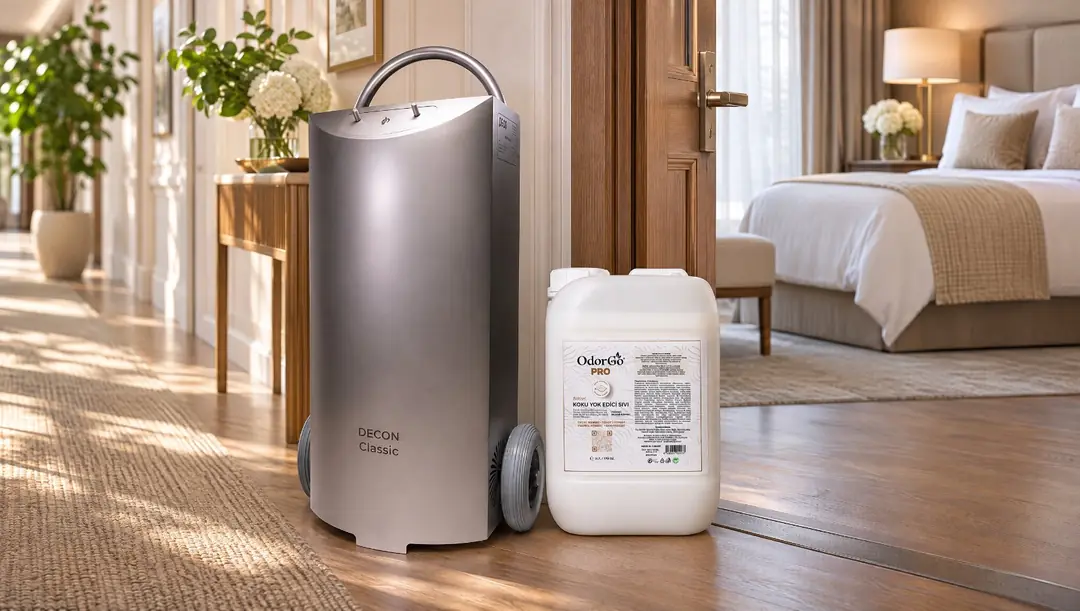
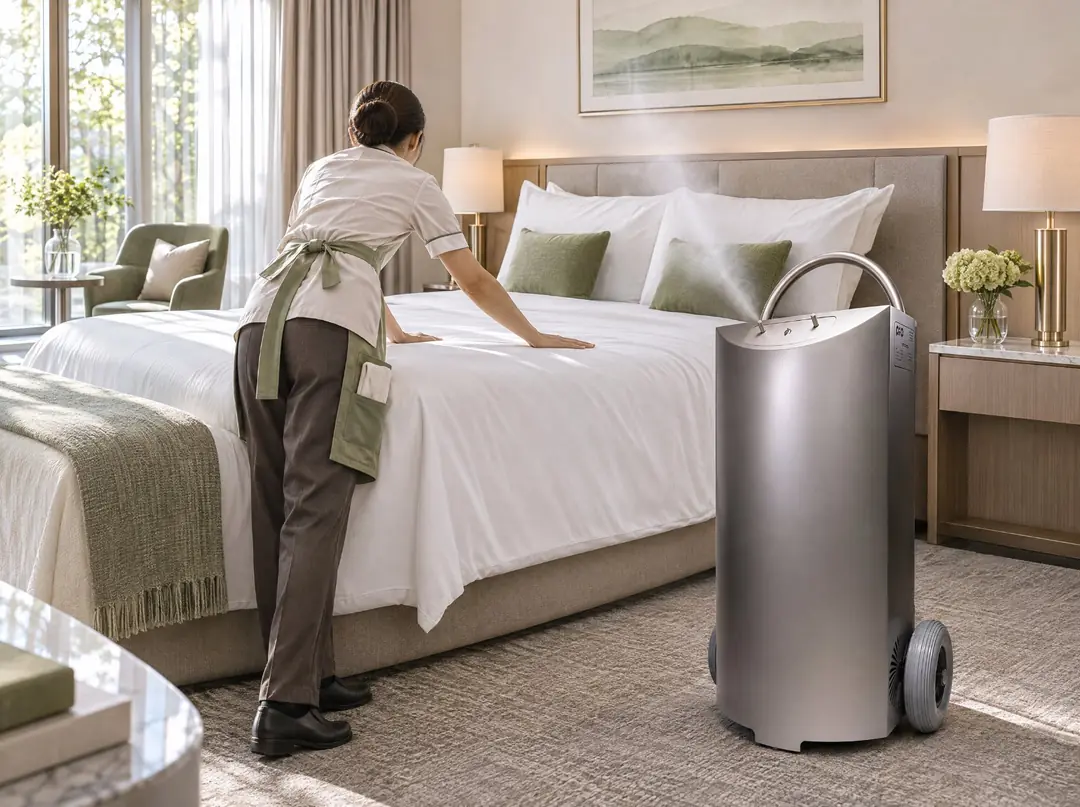
Decon Duo Classic 250D: A mobile aerosol device designed for hotels. In its odor program it works with ODORGO PRO odor-eliminating liquid (from a 5-liter container) and sprays the product intermittently: in a standard hotel room, a cycle of 5 seconds of spraying followed by a 10-second pause, for 5 to 10 minutes. A 5-minute application uses about 100 grams of product per room. This cycle was chosen so that it doesn't set off the fire alarm. For lobbies, restaurants and large smoking areas, 5 seconds of spraying followed by a 2-minute pause is recommended. The device's odor program is set for a volume of 280–300 m³.
The biggest difference from ozone shows up in day-to-day housekeeping: while Decon Duo is running, the housekeeper can keep making the bed and wiping down the bathroom. No waiting or ventilation is needed after application; the room can be used right away. The one thing to watch is noise: the device is about as loud as a vacuum cleaner, so running it while a guest is in the room is not recommended.
ODORGO PRO Odor Eliminator Spray 500 ml: Housekeepers apply it directly to specific spots such as curtains, armchairs, carpets and bathrooms. It's water-based and contains plant essential oils (lime, pine needle, cedarwood, anise and clove), but no added perfume. The essential oil content is at least twice that of the standard product. It's used for cigarette smoke, dampness, mold, urine, food and garbage odors.
ODORGO Odor Eliminator Gel 250 g: Works continuously wherever you place it, in closets, bathrooms and enclosed spaces; it lasts up to 30 days in enclosed spaces of up to 15 m².
If the cigarette odor is years old, no single product will be enough. Curtains and bedding get washed, the carpet gets a deep clean, and odor removal comes last. For a room-by-room plan, see our article on cigarette smell in hotels and rentals and our odor guide for restaurants, hotels and businesses.
Should you use an ozone machine at home?
We don't recommend using an ozone machine at home. CARB clearly warns the public about ozone-generating "air purifiers," and the EPA recommends proven methods, putting control of the pollution source first and ventilation second.[1][2] Most odor problems at home are solved once you find the source: fabrics when it's cigarette smoke, walls when it's damp, the trash and drains in the kitchen. For whatever odor remains, you can use ODORGO Odor Eliminator Spray 250 ml and Gel 250 g. We explain why odors shouldn't be masked on our masking vs. neutralization page.
Is ozone treatment harmful in a car?
A car cabin is small and enclosed, so ozone concentration rises quickly. No one should be in the car during treatment, and afterwards the doors should be opened and the cabin aired out thoroughly. Seat fabric, rubber seals and dashboard plastics are the parts most affected by repeated ozone treatment.[1][2] If cigarette odor has worked its way into the seat foam, ozone may not reach it; a deep clean comes first.
If you'd like an ozone-free option, the Car Odor Eliminator Set comes with a gel and a 30 ml spray.
Keep your rooms ozone-free and odor-free
Browse Products · Corporate Odor Solutions · Hotel Odor Solutions · Frequently Asked Questions
Frequently Asked Questions
Is an ozone machine harmful to human health?
Yes, it can be harmful in an occupied space. Ozone irritates the airways; it can cause chest pain, coughing and shortness of breath, and it can make asthma worse.
Does ozone completely eliminate odors?
No, not always. According to the US Environmental Protection Agency (EPA), ozone below health limits does not remove many odor-causing chemicals, while high concentrations require an empty room and ventilation.
Can you go into the room right after ozone treatment?
No. After the device is switched off, the room is ventilated and the re-entry time in the device instructions is observed; if you have an ozone meter, the decision is based on its reading. Researchers at Lawrence Berkeley National Laboratory recommend waiting a few hours.
Can an ozone machine be run with people in the room?
No. Ozone treatment for odor removal is done only in an empty room, by trained staff.
Does ozone damage furnishings?
It can, with long-term and repeated use. Effects have been reported on fabric, rubber, carpet and paint. A single short treatment appears to have less effect, but that depends on the concentration and the material.
Can you use an odor eliminator spray together with ozone?
No. Ozone can react with the terpenes in natural plant oils and with scented products to form formaldehyde and fine particles. After ozone treatment, no odor product of any brand should be applied until the room has been aired out.
Does ozone get rid of cigarette smell?
Partly, when the smell is fresh. In a 2023 study by Lawrence Berkeley National Laboratory on carpets with years of smoke exposure, nicotine did not drop significantly; washing fabrics and deep cleaning are needed.
Can ODORGO be used with people present?
Yes. ODORGO produces no ozone, so it can be applied with people inside and while cleaning is under way. The Decon Duo device is about as loud as a vacuum cleaner, so running it while a guest is in the room is not recommended.
Does the room need to be aired out after using ODORGO?
No. No waiting or ventilation is needed after applying ODORGO or using Decon Duo; the room can be used right away.
Does an ozone machine cause cancer?
Ozone itself is not classified as a carcinogen. But formaldehyde can form when ozone reacts with terpenes indoors, and the International Agency for Research on Cancer (IARC) lists formaldehyde as carcinogenic to humans (Group 1).[4][17]
Does ozone get rid of mold and musty smells?
Not permanently. Unless the source of the moisture is dried out and the mold is cleaned, the smell comes back; odor removal comes last.
What do hotels use instead of ozone?
Source cleaning and odor eliminators that don't produce ozone. ODORGO is applied with the Decon Duo device and with the PRO spray, without producing any ozone.
Sources
- US Environmental Protection Agency (EPA). Ozone Generators that are Sold as Air Cleaners. https://www.epa.gov/indoor-air-quality-iaq/ozone-generators-are-sold-air-cleaners (PDF version: https://www.epa.gov/sites/default/files/2014-08/documents/ozone_generator.pdf)
- California Air Resources Board (CARB). ARB Warns – Danger from Popular "Air Purifying" Machines. https://ww2.arb.ca.gov/news/arb-warns-danger-popular-air-purifying-machines
- Tang X, Gambier C, Lopez-Galvez N, Padilla S, Rapp VH, Russell ML, Klivansky LM, Mayorga R, Perrino C, Gundel LA, Hoh E, Dodder NG, Hammond SK, Zhang H, Matt GE, Quintana PJE, Destaillats H. Remediation of Thirdhand Tobacco Smoke with Ozone: Probing Deep Reservoirs in Carpets. Environmental Science & Technology, 2023; 57. Digital Object Identifier (DOI): 10.1021/acs.est.3c01628. https://doi.org/10.1021/acs.est.3c01628
- Destaillats H, Lunden MM, Singer BC, Coleman BK, Hodgson AT, Weschler CJ, Nazaroff WW. Indoor Secondary Pollutants from Household Product Emissions in the Presence of Ozone: A Bench-Scale Chamber Study. Environmental Science & Technology, 2006; 40(14): 4421–4428. https://eta-publications.lbl.gov/publications/indoor-secondary-pollutants-household
- Health Canada. Residential Indoor Air Quality Guideline: Ozone, 2010. https://www.canada.ca/en/health-canada/services/publications/healthy-living/residential-indoor-air-quality-guideline-ozone.html
- World Health Organization (WHO). WHO Global Air Quality Guidelines, 2021. https://www.who.int/publications/i/item/9789240034228
- Republic of Türkiye, Regulation on Health and Safety Measures for Working with Chemical Substances (Official Gazette 12.08.2013/28733; Annex 1 as amended 20.10.2023/32345). https://www.mevzuat.gov.tr/mevzuat?MevzuatNo=18709&MevzuatTur=7&MevzuatTertip=5 · Downloadable copy: https://trigonium.com.tr/indir/kimyasal-maddelerle-calismalar-yonetmeligi
- Commission Implementing Regulation (EU) 2023/1078: approval of ozone generated from oxygen as an active substance for use in biocidal product types 2, 4, 5 and 11. https://eur-lex.europa.eu/eli/reg_impl/2023/1078/oj
- US National Institute for Occupational Safety and Health (NIOSH). Pocket Guide to Chemical Hazards: Ozone. https://www.cdc.gov/niosh/npg/npgd0476.html
- Weschler CJ. Ozone in Indoor Environments: Concentration and Chemistry. Indoor Air, 2000; 10(4): 269–288. DOI: 10.1034/j.1600-0668.2000.010004269.x. https://doi.org/10.1034/j.1600-0668.2000.010004269.x
- Kobayashi Y, Yoshizumi K. Morphological Observation of Surface Deterioration of Cotton, Silk and Nylon Fabrics due to Exposure to Nitrogen Dioxide and Ozone Gases. Journal of Home Economics of Japan, 1998; 49(8): 893–898. DOI: 10.11428/jhej1987.49.893. https://www.jstage.jst.go.jp/article/jhej1987/49/8/49_8_893/_article
- Bogaty H, Campbell KS, Appel WD. The Oxidation of Cellulose by Ozone in Small Concentrations. Textile Research Journal, 1952; 22(2): 81–83. https://doi.org/10.1177/004051755202200202
- Wiesinger R, Martina I, Kleber Ch, Schreiner M. Influence of Relative Humidity and Ozone on Atmospheric Silver Corrosion. Corrosion Science, 2013; 77: 69–76. https://doi.org/10.1016/j.corsci.2013.07.028
- Volkoff SN et al. Demonstrated SARS-CoV-2 Surface Disinfection Using Ozone. Ozone: Science & Engineering, 2021; 43(4): 296–305. DOI: 10.1080/01919512.2020.1863770. https://stacks.cdc.gov/view/cdc/230387/cdc_230387_DS1.pdf
- California Code of Regulations (CCR), 17 CCR §94801–94803, Indoor Air Cleaning Devices Regulation, §94801(a)(19)(C). https://ww2.arb.ca.gov/resources/documents/indoor-air-cleaning-devices-regulation
- Lawrence Berkeley National Laboratory News Center. Ozone Generators May Help Remediate Contamination Caused by Thirdhand Smoke, January 14, 2021. https://newscenter.lbl.gov/2021/01/14/ozone-generators-may-help-remediate-contamination-caused-by-thirdhand-smoke/
- International Agency for Research on Cancer (IARC). IARC Monographs Volume 100F: Chemical Agents and Related Occupations — Formaldehyde, 2012. https://publications.iarc.who.int/123